10 Books That Made Me a Better Leader
And I'd Hand You Before You Start a Business
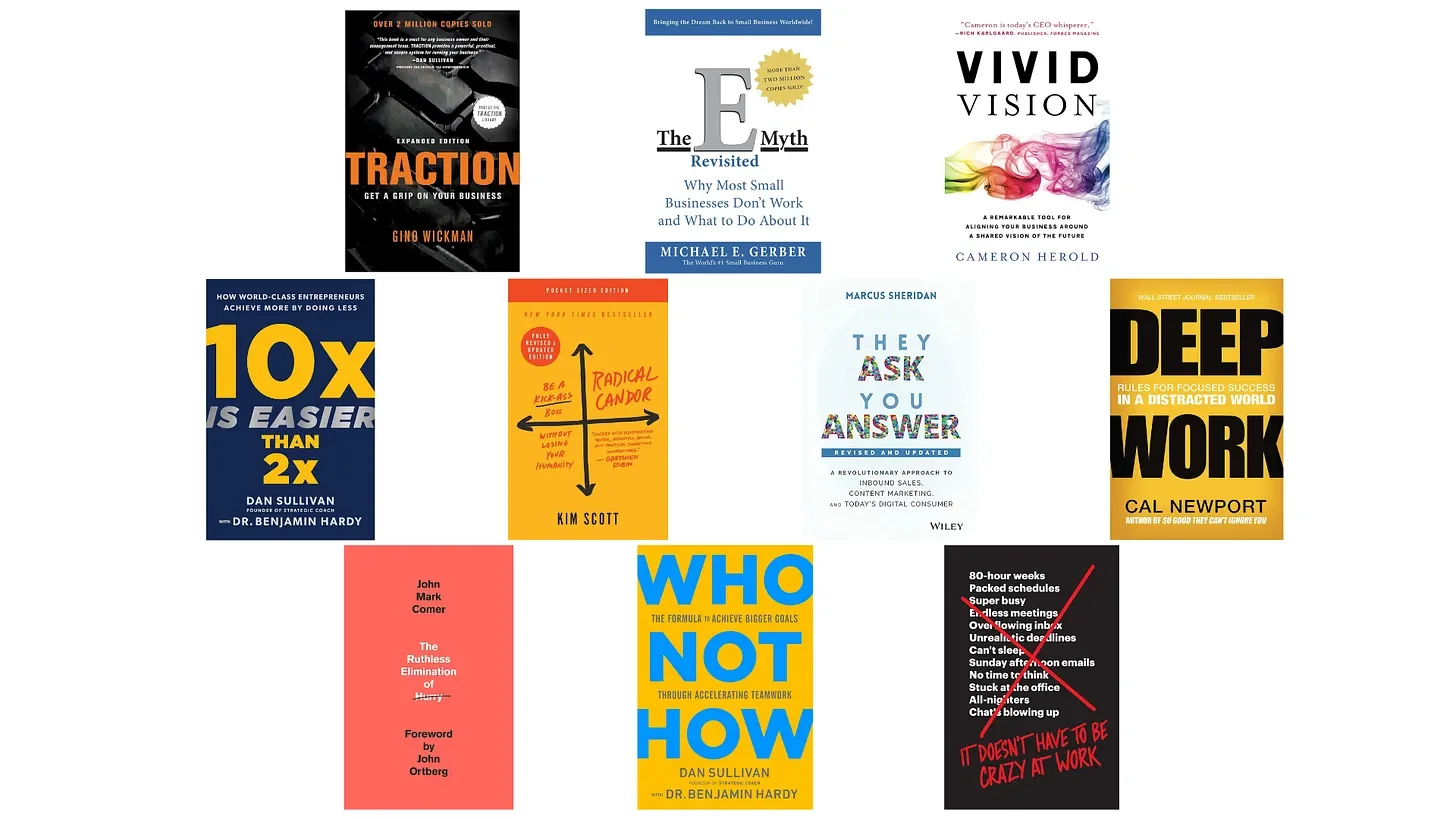
If someone told me they were thinking about leaving their job to start a business, I wouldn’t give them advice.
I’d give them a stack of books.
Not because I don’t have thoughts on the matter, but because the lessons I’ve learned over the past decade of entrepreneurship didn’t come from me figuring things out on my own. They came from people who had already walked the path and were generous enough to write it down.
These are the books that met me where I was. Some found me when I was burnt out and barely holding on. Others found me when I was stuck in my own head, convinced I had to do everything myself. A few found me before I even knew I needed them.
Whether you’re thinking about starting something of your own, feeling stuck in your current role, or already running a business and wondering why it feels harder than it should, these books will help.
Business should power life, not drain it. And these books taught me how to make that true.
Vision and Mindset
1. Vivid Vision by Cameron Herold
This book got me to think about my business beyond the day-to-day.
Cameron Herold asks you to imagine your business three years from now, and not in a “set some reasonable goals” kind of way. He wants you to think about a future state where everything worked out perfectly, where you got everything you wanted. What does that life look like? What does that business look like? What are you doing every day?
The exercise felt scary at first, honestly. But then I thought: why not me? What’s actually stopping me from achieving this, especially if I write it down and ask people to come alongside me and support it?
That’s the point of the vivid vision. You share it with others so they can hold you accountable, so they can see it unfold with you, so they can celebrate the milestones and keep you on the path when things get hard.
For me, this was about setting myself apart. Creating a future that was desirable not just for me, but for the kind of people I wanted to work with.
Read this if: You’ve been playing small and know you need to think bigger.
2. 10x Is Easier Than 2x by Dan Sullivan
What really stood out for me in this book was the idea that if you set your sights on 2x growth, you’re going to stay small. You’ll think about the activities that get you incremental improvement. But if you start thinking from a 10x mindset, everything changes.
And the goal isn’t necessarily to hit 10x. It’s shoot for the moon and land amongst the stars.
What would have to change in my business, in my life, for me to 10x? What would have to be so transformational? When you start asking those questions, you start thinking differently about who you hire, what you engage in, where you spend your time. You start thinking differently about who you are and how you operate.
That shift was transformational for me. It got me out of the “I can 1x or 2x my business” mentality and into something bigger.
Read this if: You’re playing it safe and wondering why growth feels so slow.
Systems and Structure
3. The E-Myth Revisited by Michael E. Gerber
A friend gave me this book when I was a General Manager at Goodlife Fitness, and my twin boys were on the way. I was doing freelance work on the side, thinking about what a business of my own could look like, and he handed me this book and said I needed to read it.
What really resonated with me was when Michael Gerber talks about the entrepreneurial seizure. The technician who thinks they can do it better than their boss, so they go out and start their own thing, and then they realize there’s so much more to running a business than they ever considered.
I had already been doing freelance work at that point. I was also playing in an actively managing a band, handling bookings, finances, admin, and everything in between. I’d also been running a recording studio out of my house for the past couple of years, where I was the technician doing the recording, but also the person mixing, running the website, doing the marketing, as well as sending invoices and balancing the books.
So I knew what it took to at least take on the added responsibility, but I didn’t yet understand or feel the weight of running a business that would fully support my family. This book confirmed my understanding, challenged me to look at entrepreneurship differently, and helped me see the real value of documenting standard operating procedures.
Read this if: You’re thinking about leaving your job to start something and want to know what you’re really signing up for.
4. Traction by Gino Wickman
I first read this book around the same time I read E-Myth Revisited, but I didn’t appreciate it for what it was. It wasn’t until years later, when I was running Cirface and the business was just getting started, that I came back to it and devoured every single word.
And I didn’t just read it this time. I stopped at every single chapter to implement exactly what it said before moving on.
This was late 2023. I was super burnt out. Earlier that year, my house was involved in a series of wildfires that tore through Nova Scotia, and my family was living in a short-term rental while my wife and I seriously contemplated our life choices. Needless to say, I was at my lowest point depression-wise. I wasn’t taking care of myself, and my business, along with project managing my home’s restoration, was draining me.
I had loosely run EOS up to this point and was somewhat familiar with it, but I hadn’t respected it for what it was. This was my reintroduction, and it was transformational.
So much so that we now fully run on EOS, and I’m even starting an EOS-focused business. EOS gave me the solid foundation my business was missing and allowed me to build a more predictable structure based around vision, data, process, traction, issues, and people.
Simply put, it was the lifeline I needed.
Read this if: Your business feels chaotic and you need a system to bring order to it.
Leadership and People
5. Radical Candor by Kim Scott
I read this when I was managing at Goodlife Fitness, and it was the book that helped me understand how to manage people. Now, I don’t love managing people. I wish I didn’t have to, truthfully. But it’s an inevitable part of the job.
What Kim Scott teaches is how to give direct feedback without being mean, without disrespecting people, without disrespecting yourself. How to give timely and constructive feedback in a way that’s helpful and builds people up rather than tearing them down.
There are so many bad managers out there, and that’s what Kim is trying to fix. She wants there to be no more bad managers because there are already enough of those in the world.
This book helped me in my corporate job, and it helped as I started hiring and onboarding people into my own business. It gave me a framework for having those real conversations that need to happen all the time.
Read this if: You’re leading people and want to be the kind of leader you wish you’d had.
6. Who Not How by Dan Sullivan
For a long time, I felt like I had to do everything myself. I was the best at it. I could do it faster. And so I’d stay up until 3 AM trying to get it all done because I couldn’t let go.
This book flipped that thinking on its head.
The question isn’t “how do I do this?” It’s “who can do this better than me?” Because my job is to stay in the zone (my zone of genius) where I’m uniquely positioned to add value. Someone else can do the admin. Someone else can do the operations. Someone else can do the sales and the marketing. My job is to find those people, people who are smarter than me, more capable than me, with more capacity than me.
This book is what pushed me to hire my first executive assistant. It got me thinking about who my head of delivery would be (one day), who my head of marketing would be. It helped me start seeing myself as someone who sets vision, not someone who does all the work.
Read this if: You’re drowning in tasks and can’t figure out how to get your time back.
Focus and Pace
7. Deep Work by Cal Newport
This one found me during COVID. Kids were home, things were chaotic, and I couldn’t focus. I had three screens on my desk plus my laptop, Slack messages going off, email coming in, and my head was on a swivel. There was my phone too. I couldn’t get anything done, which is another reason why I was staying up until 3 AM every single day.
Cal Newport taught me that deep work is a skill to be honed. You have to work at it and protect it. I learned about time blocking and how to actually implement it, how to respect my time by creating appointments with myself to do focused work. Because if I wasn’t doing deep work on the business, I wasn’t growing the business. If I wasn’t doing deep client work, I wasn’t doing my best work.
So now, when it’s time to work, I shut everything else off. I go to one screen, set a timer, put it in my calendar, and make sure update my Slack status for that block. Put on the headphones, turn off the notifications, and get in the zone.
That changed everything about how I work and how I execute on the tasks that only I can do.
Read this if: You’re busy all day but never feel like you’re making real progress.
8. The Ruthless Elimination of Hurry by John Mark Comer
People ask me about this book and are surprised when I tell them it’s written by a pastor. But it works because anyone who reads it can see themselves in it. That is because, you see, burnout is universal. We’ve all experienced it or are on our way there.
John Mark Comer writes about his own burnout, about reaching the point where he couldn’t go forward anymore and needed to step back from his position and take a break. And that resonated deeply with me. I was the guy who thought I had to get back to every email immediately. I had to be at inbox zero. I had to respond to that customer right now.
But no. You don’t.
Actually, it was my therapist at the time who helped me to realize these as self-imposed requirements. I felt like if I didn’t respond right away and didn't have the right answer, they would fire me, and I couldn’t handle the stress of scrambling to find a new client.
I lived like this for years, and it ruined me.
You need to create space. You need to create time with your family. You need to create time with God. To live a life that is fulfilling, you have to remove hurry, remove stress, remove complexity, remove overwhelm.
From that point forward, I made it a goal of mine to ruthlessly eliminate hurry in everything I do. To not let anyone dictate my stress levels or my day. To do things at the pace that I want to.
Read this if: You’re exhausted and don’t remember the last time you felt at peace.
9. It Doesn’t Have to Be Crazy at Work by Jason Fried and David Heinemeier Hansson
This one is a quick read; I got through it in one sitting (maybe five or six hours), but it completely reframes how you think about work.
The authors show you that leaders are the ones who create the chaos. Nothing is actually that urgent. Nothing is actually on fire. Nothing is truly mission-critical. We create this stress. And we breed employees who continue operating like this.
This becomes your culture.
I read this when I was running my marketing agency, back when everything felt chaotic and stressful and like the world was ending every other day. And it was such a relief to be reminded that no, it’s not. This isn’t brain surgery. This isn’t nuclear science. No one is dying. The work we’re doing is important, but not that important.
So have fun with it. Make mistakes. No one needs to get yelled at. No one needs to feel inadequate. We’re all just humans trying to do the best we can.
Read this if: You’ve convinced yourself that the stress is just part of the job.
Growth and Content
10. They Ask You Answer by Marcus Sheridan
I read this when I was running my marketing agency Media Crate, and I was trying to figure out how to create content that was actually worth reading.
What was eye-opening about Marcus’s approach was how simple it is. Your customers are asking you questions all the time. They’re sending emails, leaving comments, asking the same things over and over. And most businesses just brush those questions off. They answer them one-off and move on.
But Marcus says you should turn those questions into content. Put them in a knowledge base. Write a blog post. Create a video.
That thinking is what eventually led me to start my YouTube channel. When I was running my next business, Ditto, I was getting the same questions from customers about how to use our social media calendar inside Asana. So I thought, let me just create a video for it and share it that way.
That one shift, treating customer questions as content opportunities, changed how I thought about marketing entirely.
Read this if: You’re struggling to figure out what to create content about.
Start Here
If you’re thinking about starting a business, read E-Myth Revisited first. It’ll show you what you’re signing up for.
If you’re already running something and feel like you’re drowning, start with Traction and Who Not How. They’ll give you the systems and the permission to let go.
If you’re burnt out and wondering why you started this in the first place, pick up The Ruthless Elimination of Hurry. It might be exactly what you need.
And if you just need someone to remind you that you’re allowed to dream bigger than you’ve been dreaming, read Vivid Vision and 10x Is Easier Than 2x.
These books didn’t just make me a better leader. They made me a better person.
I hope they do the same for you.